Unfortunately, Italian Brain Rot Might Matter
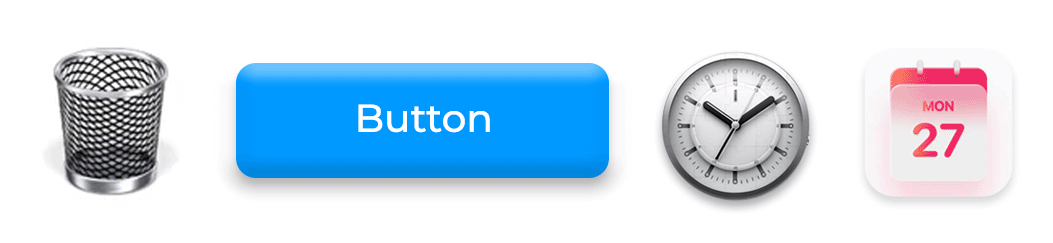
I was talking with my UI/UX students about skeuomorphism the other day. Specifically, the old beveled button thing. The way early digital interfaces borrowed from physical objects so people knew what they were looking at. A button looked raised because a physical button was raised. A folder looked like a folder because people knew what folders were. A trash can meant delete because, well, we throw things in trash cans.
The bevel taught you where to press.
And then one of my students asked a really good question.
“How do we know when we don’t need that anymore?”
And, dang, that’s the whole thing, isn’t it?
Because we don’t really need the bevel anymore. Not in the same way. A button can just be text, or a shape, or an icon, or sometimes nothing more than its placement in a familiar pattern. We know where to press because we’ve learned how to read the interface. The metaphor did its job. It trained us. Then it got out of the way.
That’s the part I can’t stop thinking about with AI.
Right now, so much of what we make with AI still has the bevel on it.
We ask AI to make a photograph. An essay. A song. A movie trailer. A slide deck. A website. A fake commercial. A fake Pixar thing. A fake Wes Anderson thing. A fake version of some older form we already know how to read.
And that makes sense. I don’t mean that as an insult. We understand new things through old things. We use what we know to make sense of what we don’t. That’s not just design. That’s learning. That’s culture. That’s meaning-making. That’s how we keep from staring at something new and having our brains fully reject it.
We recreate the past while we learn how to make the future.
Early film did this. At first, film was amazing because it moved. Workers leaving a factory. A train arriving. A stage act recorded by a camera. A magic trick. A performance. It was enough that the thing existed. Look, the world is moving on a screen.
Then people started figuring out that film did not have to just record the world. It could bend it. Cut it. Rearrange it. Make impossible space. Make time jump. Make meaning happen between two images instead of inside one image.
At some point, film stopped needing to prove it could capture theater or reality and started becoming cinema.
The bevel started falling off.
I think that is where AI is right now, or at least where I hope it is going. We’re still impressed that the thing can make a picture, or a paragraph, or a voice, or a video. We’re still asking it to imitate old forms because that gives us something to hold onto and judge it by.
But the interesting question is not whether AI can make a fake movie, but whether AI needs to look like a movie at all.
I was listening to an episode of Dissect about Daft Punk’s “Harder, Better, Faster, Stronger”, a song you may know even if you don’t know the name. It’s the one with the clipped, robotic voice repeating the title over and over. Cole Cuchna talks about the vocoder, the effect that gives the voice that machine-like quality, as a transition point between human and machine. The voice is human…but not. Robotic…but not just robotic. By the end of the song, the machine voice isn’t just a gimmick or a filter sitting on top of the human. It becomes the thing throwing down crazy improvisational-ish guitar-ish solos. It’s wild. It became its own language.
That feels important because the vocoder isn’t interesting on its own. Sure, it’s fun, but it only got interesting when artists got in there and figured out how to make that human-machine collaborative space beautifully expressive. And that expressive weirdness became the point. The instability became the material.
That’s the thing I’m trying to figure out with AI.
A lot of AI work right now is trying to sand off the weirdness. Make the image more realistic. Make the writing sound more human. Make the video less janky. Make the tool disappear. And again, I get that. Sometimes that is the goal. Sometimes you need the thing to be clean and usable and invisible. There’s always a space for that.
But I think the native language of AI starts somewhere else. Maybe it starts with the weird failures and hallucinations.

I draw this line for my students all the time. On one side is the human. On the other side is the computer. Every creative decision moves somewhere along that line. More human here. More machine there. More control here. More randomness there.
There’s no universal right answer. There’s only intention, purpose, and the balance of the thing you’re trying to make.
That balance is where the play happens.
And play matters here. Not play as in “this is unserious.” Play as in testing the edges of a system. Play as in finding out what the rules are by bending them. Play as in letting the tool do something weird enough that you finally understand it differently. Something that speaks its own language…kinda like memes, right?
Memes aren’t just dumb internet stuff. I mean, they’re usually dumb internet stuff, but they’re also language. They’re inside jokes that escaped containment. The proof that a group of people understands a system well enough to compress it, distort it, repeat it, mutate it, and still recognize it. I mean…maybe that’s cultural literacy?
Once people can joke inside a form, they’re not just reading it anymore; they’re literate. They’re speaking its language.
That’s semiotic confidence. Or at least I think that’s what I’m circling around. The inside jokes, or signs, stop needing to explain themselves to everyone. They start speaking directly to the people who know how to read them.
A bevel is semiotics in training.
It borrows an old sign so we can understand a new system. But once the new system has its own signs, its own jokes, its own shorthand, its own weird little rules, the bevel isn’t doing the same job anymore. It starts becoming extra. Or worse, it starts getting in the way.
Which is why I hate that Italian brain rot might matter here.
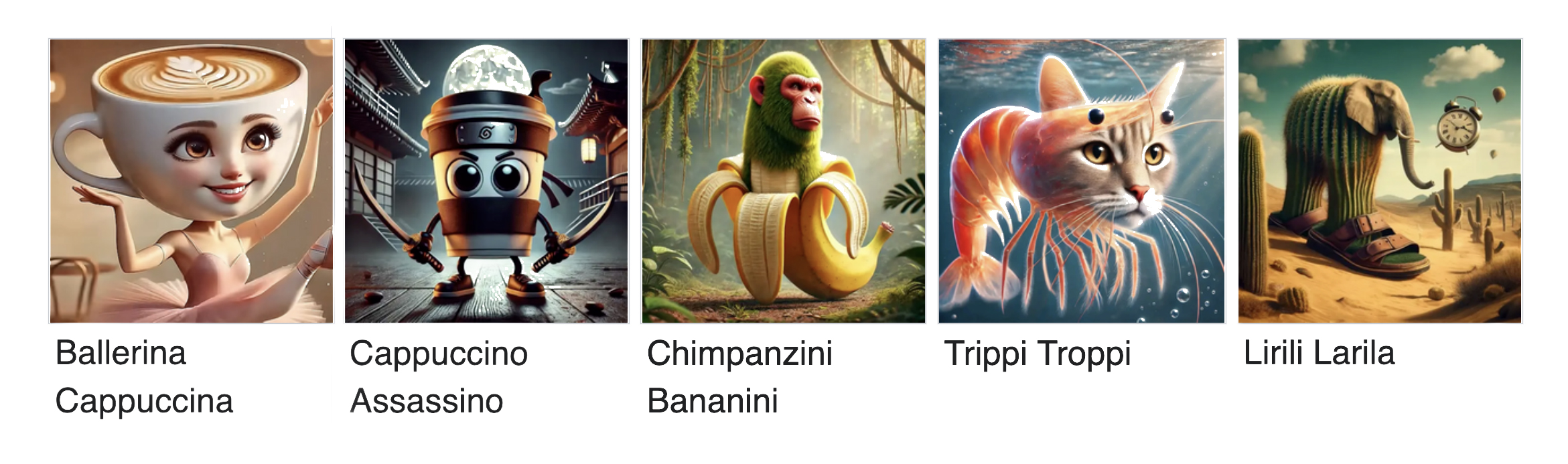
I don’t mean that Italian brain rot is good. I don’t even know if “good” is the right category. But it feels closer to something AI-native than another fake movie trailer does.
It’s weird. It’s dumb. It’s fast. It mutates. It’s got characters and rhythms and patterns and references that make sense inside the community before they make sense outside of it. It’s not trying very hard to pretend it is not AI; it’s not embarrassed to be seen as the machine doing its weird thing. The synthetic wrongness is part of the joke.
I guess I’m trying to say that maybe Italian brain rot is AI with the bevel scraped off.
Not because it’s polished, or “the future,” or anything like that. But it does point toward a moment where people stop asking AI to prove it can imitate old media and start using it to make strange little languages of its own.
And the stupid perfect twist is that even while I’m looking at Italian brain rot as some possible edge of AI-native culture, you can already buy a piece of that edge from Walmart for $14.99 plus shipping and handling.

Because of course you can.
That’s how this works now. The weird inside joke becomes readable, then popular, then product, then normal, then the next bevel.
Today’s weird little inside joke is tomorrow’s interface convention.
Maybe that’s too clean…it’s probably messier than that. But I do think the cycle is there. The strange thing becomes legible. The legible thing becomes shared. The shared thing becomes commercial. The commercial thing becomes normal. The normal thing becomes the bevel someone else has to scrape off later. I’m just thinking of how many times I’ve tried to use rizz to embrace my Gen Alpha pre-teen. He probably wants to scrape me off.

So maybe it’s not important to know when the bevel falls off because it’s always falling off. We just need to look for where we’re supposed to press.
Where are people already using AI without needing it to look like the past? Where are they building signs I don’t know how to read yet? Where are they making jokes that sound like nonsense from the outside but make perfect sense to them?
I don’t know what AI without the bevel looks like yet.
But I’m trying to keep my peepers open.
And Italian brain rot, unfortunately, I’m looking at you.